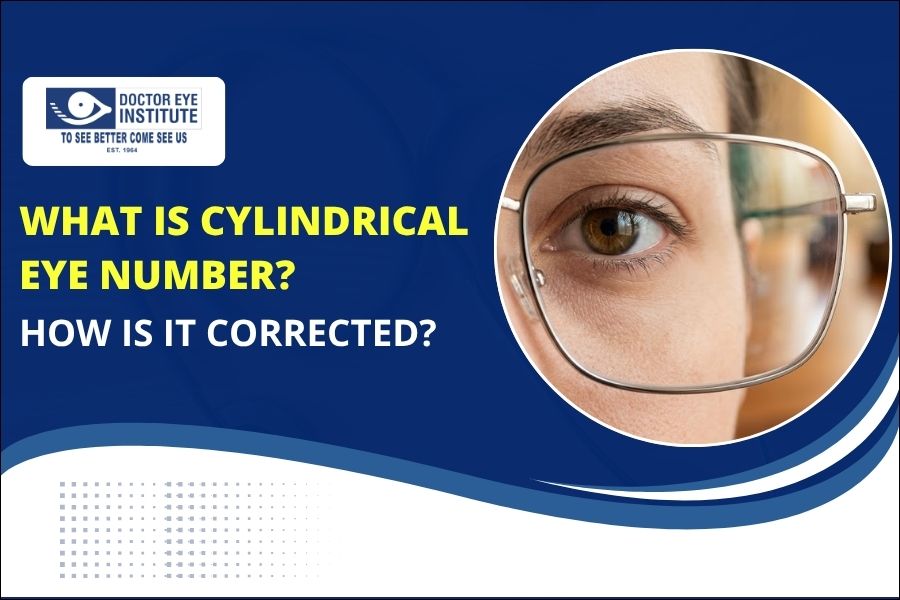
Have you ever looked at your eye prescription and noticed a number under “CYL” or “Cylinder”? If so, you may have wondered what it means and whether a cylindrical eye number is something to worry about.
A cylindrical eye number is related to astigmatism, a common type of refractive error. It can cause blurred or distorted vision at different distances. The good news is that astigmatism can usually be corrected effectively with glasses, contact lenses, or, in suitable patients, laser vision correction.
What Is a Cylindrical Eye Number?
A cylindrical eye number, often called cylindrical power or cylinder power, indicates the amount of astigmatism present in your eye.
In a normal eye, the cornea and lens help focus incoming light onto the retina. With astigmatism, the curvature of the cornea or lens is not perfectly uniform. Instead of having a more evenly rounded shape, the surface may be slightly more curved in one direction than another. As a result, light may not focus at a single point on the retina, leading to blurred or distorted vision.
For example, your eye prescription may look something like:
SPH: -2.00
CYL: -1.00
AXIS: 90°
Here, SPH represents the spherical power, while CYL represents the cylindrical correction required for astigmatism. The AXIS indicates the orientation of the cylindrical correction and is measured in degrees.
What Does Cylinder Power Mean in an Eye Prescription?
Cylinder power is measured in dioptres (D). The number tells your eye doctor how much cylindrical correction is required to compensate for astigmatism.
The axis is also an important part of the prescription. It ranges from 0 to 180 degrees and tells the optical laboratory or contact lens specialist the direction in which the cylindrical power should be positioned.
This is why simply knowing your cylinder number is not enough to understand your complete prescription. The cylinder power and axis work together to correct astigmatism accurately.
What Are the Symptoms of Cylindrical Eye Power?
A small amount of astigmatism may not always cause noticeable symptoms. However, as the cylindrical power increases, some people may experience:
- Blurred or distorted vision
- Difficulty seeing clearly at night
- Eye strain
- Frequent headaches
- Difficulty focusing for long periods
- Squinting to see clearly
- Tired eyes after reading or screen use
Astigmatism can occur along with short-sightedness (myopia) or long-sightedness (hyperopia).
If you regularly experience blurred vision or headaches, it is better to have a comprehensive eye examination rather than assuming that you simply need stronger glasses.
How Is Cylindrical Eye Power Diagnosed?
An eye specialist can identify astigmatism during a routine eye examination. Refraction tests help determine the spherical and cylindrical components of your prescription.
During the examination, the doctor may fine-tune the cylinder power and axis to determine the clearest possible correction. A technique called Jackson cross-cylinder testing may be used to refine the cylindrical power and axis during subjective refraction.
In some cases, additional tests such as corneal topography may be recommended, particularly when the doctor needs more information about the shape of the cornea or suspects an irregular corneal condition.
Regular eye examinations are especially important if your cylindrical power is changing frequently or if your vision remains blurred even with updated glasses.
How Is Cylindrical Eye Number Corrected?
The right treatment depends on the amount and type of astigmatism, your age, eye health, lifestyle, and overall eye examination.
1. Glasses
Prescription glasses are the simplest and most common way to correct cylindrical eye power.
Cylindrical lenses are designed to compensate for the uneven focusing caused by astigmatism. Your prescription may contain both spherical and cylindrical powers.
For many people, properly prescribed glasses provide clear and comfortable vision without requiring any further treatment.
2. Contact Lenses
People who prefer not to wear glasses may be suitable for contact lenses.
Toric contact lenses are specifically designed to correct astigmatism by incorporating cylindrical power and an axis into the lens. They can be useful for people with low to moderate astigmatism, although proper fitting is important for good vision and comfort.
Specialty contact lenses may be considered in certain cases of higher or irregular astigmatism.
3. LASIK and Other Laser Vision Correction
For selected adults who want to reduce their dependence on glasses or contact lenses, laser vision correction such as LASIK may be an option.
LASIK can correct myopia, hyperopia and astigmatism in appropriately selected patients. However, not everyone with cylindrical power is automatically a candidate for LASIK.
A detailed preoperative eye examination is necessary to assess factors such as corneal shape, corneal thickness, refractive stability and overall eye health before deciding whether laser vision correction is appropriate.
Can Cylindrical Eye Power Go Away on Its Own?
Cylindrical power is generally related to the shape and optical properties of the cornea or lens, so it does not usually disappear simply by exercising the eyes or reducing screen time.
However, your prescription can change over time. In some people, the amount of astigmatism may remain relatively stable, while in others it can change.
If your cylindrical number is increasing or your vision is becoming blurred despite wearing your glasses, an eye examination is important. Astigmatism can sometimes be associated with conditions such as keratoconus, which is another reason regular eye checks are valuable.
When Should You See an Eye Specialist?
You should consider an eye examination if you have persistent blurred vision, frequent headaches, eye strain, difficulty seeing at night, or if your glasses no longer provide clear vision.
Children should also have their vision checked when there are signs of difficulty seeing or focusing, as uncorrected refractive errors can affect visual development.
The important thing to remember is that a cylindrical eye number is common and usually manageable. The key is getting an accurate prescription and choosing the correction that is appropriate for your eyes and lifestyle.
Visit Doctor Eye Institute – Top Eye Hospital in Andheri
Doctor Eye Institute is a NABH-accredited and QIA-certified eye hospital in Andheri, Mumbai, offering comprehensive eye care and advanced vision correction services. The institute has more than 60 years of experience in eye care and provides services including vision testing, specialty contact lenses and glasses, LASIK and refractive surgery, cataract surgery, cornea care, glaucoma, retina and pediatric ophthalmology. If you have cylindrical eye power, blurred vision, or are considering options such as contact lenses or LASIK, a detailed eye examination can help determine the most suitable correction for your eyes.
Frequently Asked Questions
1. What is a cylindrical eye number?
A cylindrical eye number indicates astigmatism, a refractive error caused by an uneven curvature of the cornea or lens.
2. Is cylindrical power the same as eye power?
No. Cylindrical power specifically corrects astigmatism, while spherical power corrects conditions such as myopia or hyperopia.
3. Can cylindrical power be corrected with glasses?
Yes. Prescription glasses with cylindrical power can usually provide clear vision for people with astigmatism.
4. Can LASIK correct cylindrical eye power?
LASIK can correct astigmatism in appropriately selected patients, but a detailed eye examination is required to determine suitability.
5. Does cylindrical power increase over time?
It can change in some people. A changing prescription or worsening vision should be evaluated by an eye specialist.